

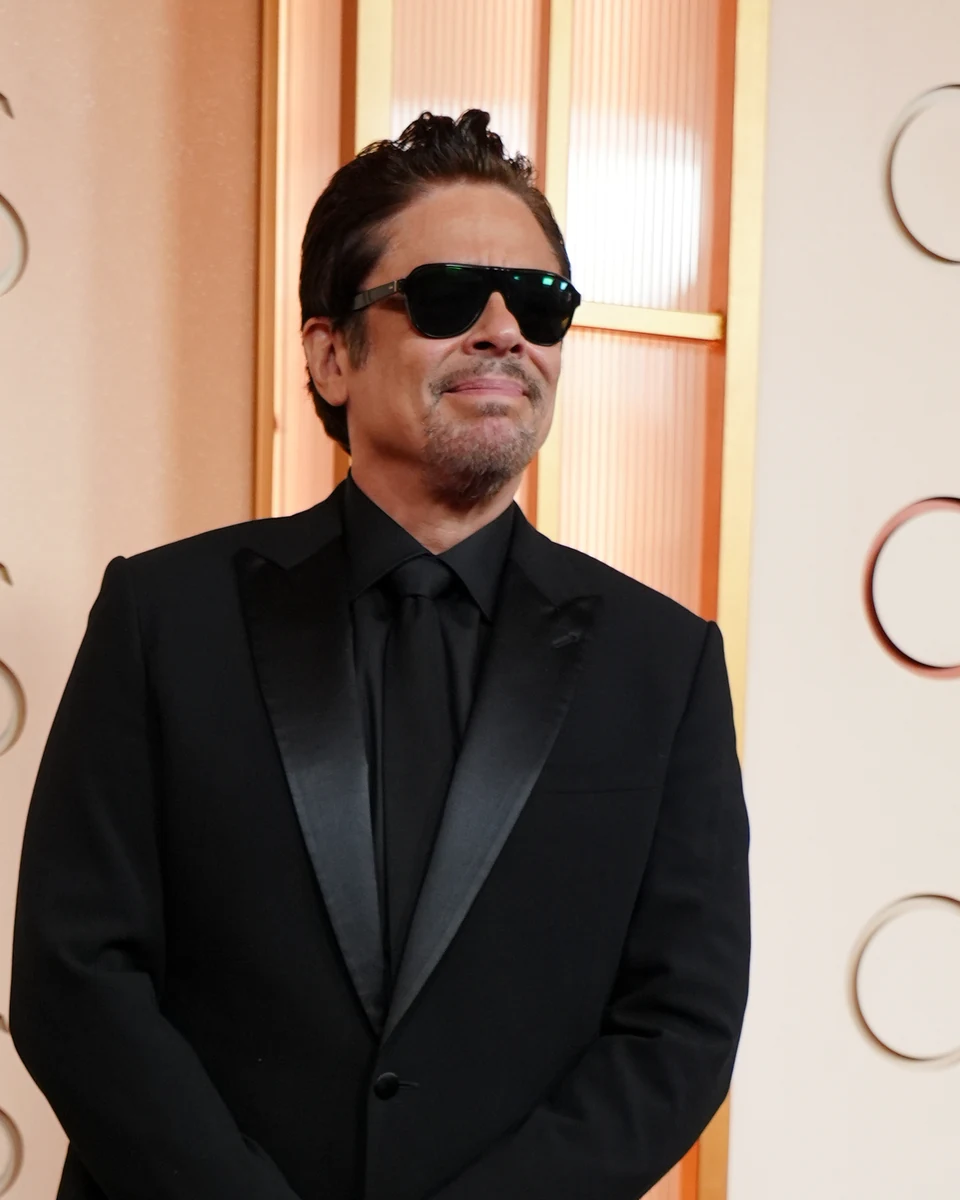
Benicio del Toro’s then-and-now comparison pairs a photograph from Cannes in 2008 with his arrival at the Oscars on 15 March 2026. The earlier image belongs to the period of Che, another major landmark after his Academy Award for Traffic. It is a useful choice because del Toro’s career has several kinds of prominence: an award-winning supporting performance, a demanding central role and memorable appearances in very different film worlds.
His recognisability does not depend only on being the loudest person in a scene. Del Toro often draws attention through timing, a withheld reaction or the feeling that a character knows more than he is saying. A photograph can suggest that presence, but it cannot fully explain it. To understand why the face became so familiar, it helps to look at what the films ask the audience to watch for.
Why 2008 is a meaningful earlier chapter
The 2008 Cannes photograph gives this page a date tied to Che. The role places del Toro at the centre of an extended historical story, rather than using him only as a disruptive or mysterious supporting presence. A historical character also brings expectations from outside the film. Viewers may arrive with a political opinion, a familiar portrait or a name they know without understanding the details.
The task for a performance is more specific than matching a famous image. A film needs a person who can listen, make decisions and occupy scenes with other people. Posture and costume can establish a recognisable outline; the work within the scene has to sustain attention after recognition has occurred. This is one reason the period makes a useful reference for a visual profile.
The photograph itself is an event picture, not a frame from the film and not an image taken in the historical period being portrayed. That distinction may sound obvious, but comparisons often blur it. Del Toro in 2008, del Toro playing a historical person and the historical person himself are three different subjects. This page compares photographs of the actor across time.
Del Toro received the best actor award for the role at Cannes in 2008. The festival’s contemporary award announcement makes this more than a convenient photo date: the image belongs to a documented moment of major recognition for the performance.
Traffic and the earlier award milestone
Traffic is an important point in the story before the displayed photograph. Del Toro plays Javier Rodriguez in Steven Soderbergh’s film, which follows connected experiences around the drug trade. The American Film Institute catalogue records the film’s credits and awards, including del Toro’s supporting actor Oscar. The role helped make his presence familiar far beyond audiences already following his work.
One useful way to approach the performance is to watch how a person operates inside a system he cannot fully control. A character’s immediate choices may be practical, while the wider consequences remain uncertain. That tension gives small exchanges importance. The audience has to notice what is being accepted, resisted or left unspoken.
This is different from a film built entirely around one central hero. In an interwoven story, a performer has to establish a compelling person quickly and keep that person’s world distinct from the others. Del Toro’s screen presence gives the viewer something to follow through the shifts. The memory is not only of a face; it is of a way of navigating pressure.
The value of an unpredictable supporting character
Some actors become memorable by making a character easy to place immediately. Del Toro can be interesting for the opposite reason. A viewer may feel that the first impression is incomplete. The way a line is delivered, an odd pause or a change in emphasis can keep attention on someone whose place in the story is not yet clear.
In The Usual Suspects, the surrounding narrative makes the reliability of information important. Del Toro’s presence is one element inside a film that asks viewers to decide what they think they know. In other roles, the effect may be comic, threatening or weary. The same performer can invite several different interpretations without making them feel interchangeable.
For someone watching after seeing the photographs, try a simple exercise: follow one of his scenes without deciding too early what the character wants. Notice when your understanding changes. The new information may come through another character’s response rather than through an explicit explanation. This is part of the pleasure of a performance that does not deliver every intention in a single clear announcement.
Sicario and the weight of silence
Sicario offers another useful point of entry. The film puts uncertainty, institutional power and violence close together, and del Toro’s character is central to the uneasy atmosphere. A viewer may spend time trying to understand his role before understanding his purpose. The performance has to remain watchable while withholding some of the information an audience normally expects from a central figure.
Silence here is not an absence of acting. It changes how the viewer attends to movement, eye contact and the space between people. A short answer can become more unsettling than a speech when the scene makes clear that the speaker has withheld something. The surrounding direction, sound and editing contribute to the effect, but the actor must give them material that holds attention.
This is a useful contrast with the historical scale of Che or the connected narrative of Traffic. Del Toro’s identity as a performer is not limited to one formula. Different films use the impression of inner life in different ways. Sometimes it helps the audience understand a person; sometimes it makes that understanding deliberately difficult.
A familiar presence in larger fictional worlds
Del Toro has also appeared in major franchise settings, including the Marvel films and Star Wars. These appearances introduce him to viewers who may not begin with a crime drama or an extended historical film. A new audience can therefore recognise the face for a very different reason from someone who followed the earlier award-winning work.
A colourful supporting part has its own demands. The character has to make an impression inside a world already crowded with unfamiliar places and people. A distinctive manner of speaking or a carefully judged reaction can establish personality without stopping the larger story. It is a different scale of storytelling from slowly revealing a central character over many scenes.
This helps explain why a then-and-now comparison should not try to assign everyone one permanent point of fame. For some readers, the earlier photograph evokes Cannes and Che. For others, the name first connects with a strange figure in a science-fiction adventure. Both routes can lead back into the wider filmography.
The current photo and a useful viewing route
The 2026 image shows del Toro arriving at the Academy Awards on 15 March in Los Angeles. The dated gallery supplies the event caption. Clothing, sunglasses, hairstyle and posture all contribute to the photograph’s impression. They are features of a specific public moment, rather than evidence from which to invent a private explanation of the years between the pictures.
Compare the earlier and current photographs first as compositions. The earlier one includes a festival setting and a different arrangement of people; the newer one presents an awards arrival. The crop used for comparison brings attention to del Toro, but the dates and event contexts still matter. A close view does not turn either picture into a neutral record made under identical conditions.
For a viewing route, begin with Traffic, continue with Sicario, and choose Che when you want the contrast of a sustained leading role. Pay attention to how each film manages what you know about his character. You can then explore Ethan Hawke’s different use of uncertainty or Michael B. Jordan’s path into major leading roles. The comparison becomes most rewarding when the photographs send you back to a performance you can see more clearly.